Recreating Real-World Driving Environments Without Moving the Vehicle
Recreating Real-World Driving Environments Without Moving the Vehicle
Recreating Real-World Driving Environments Without Moving the Vehicle
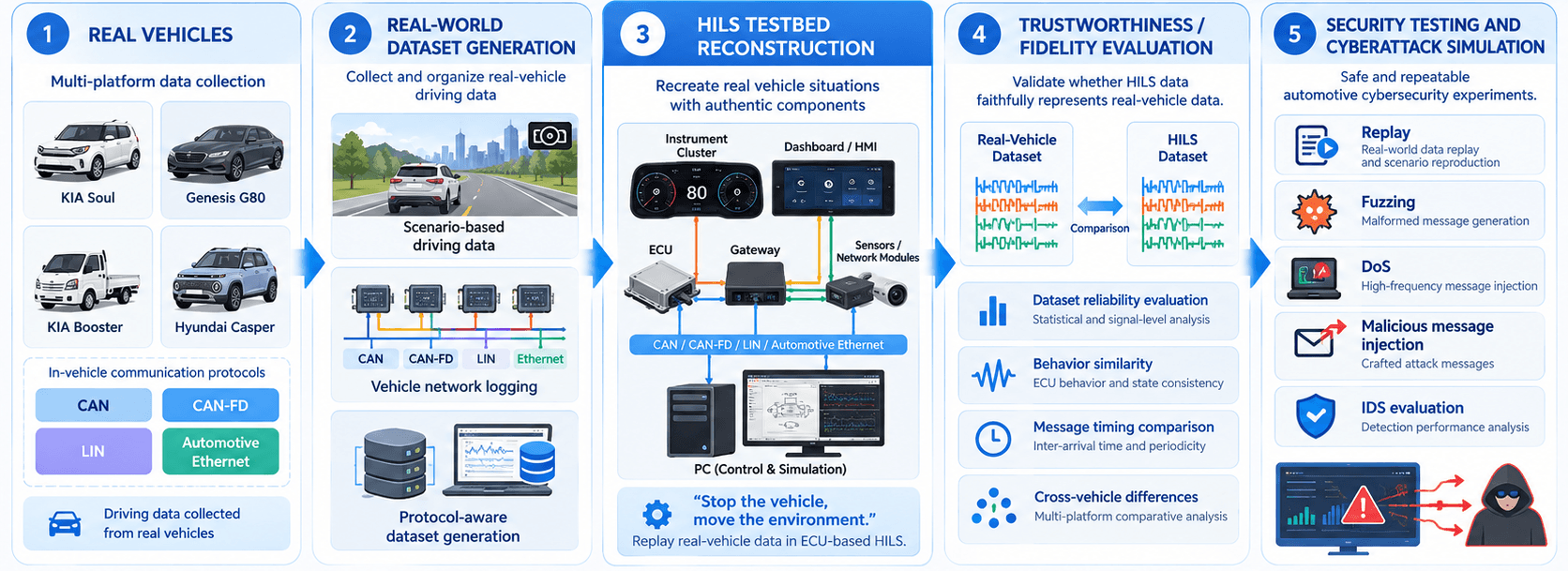
Traditional automotive cybersecurity research often requires experiments on moving vehicles, presenting significant challenges in safety, reproducibility, and experimental control. In real-world driving, the surrounding environment remains relatively stationary while the vehicle moves through it. Our research introduces a different approach: keeping the vehicle hardware stationary while recreating the changing driving environment through network data and simulation.
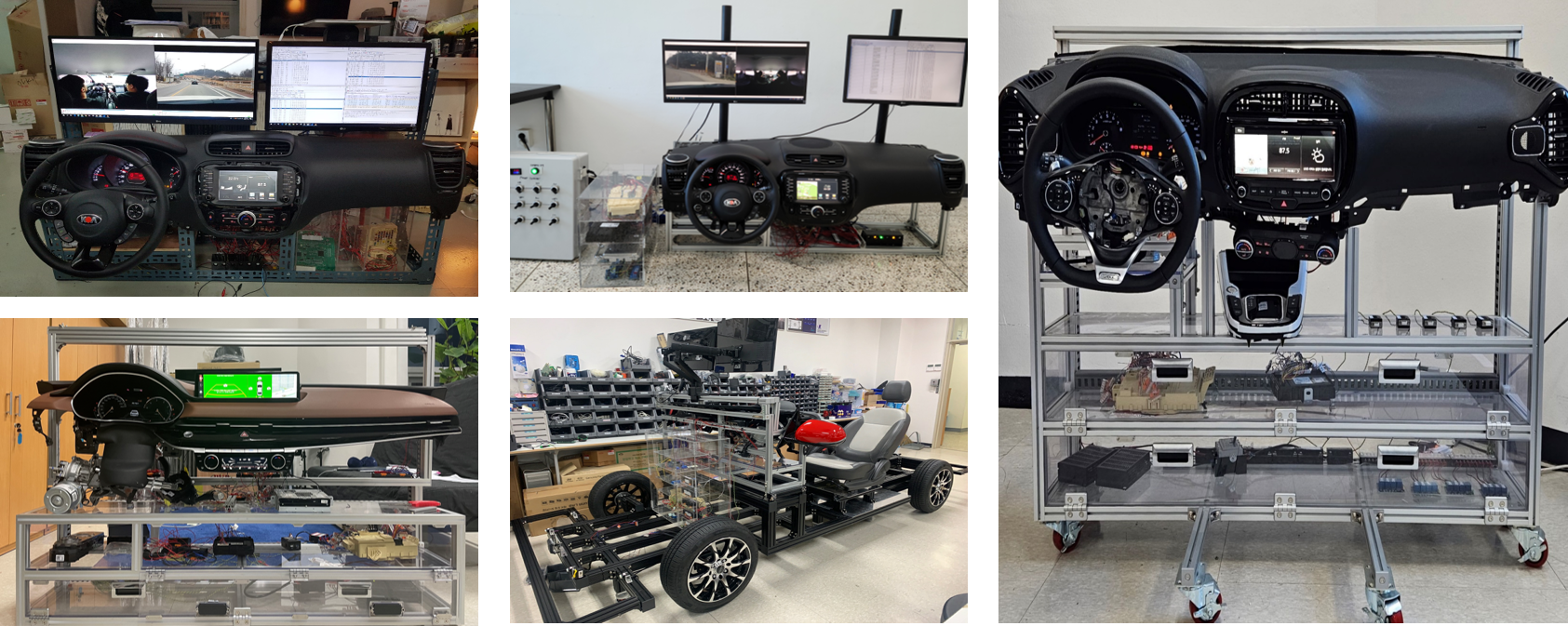
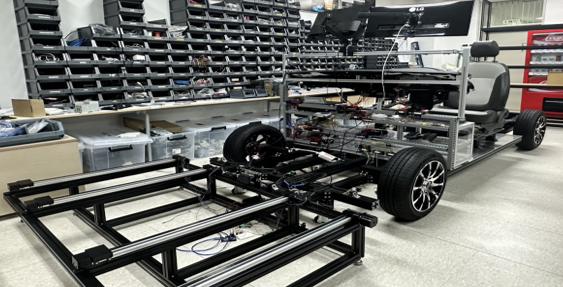
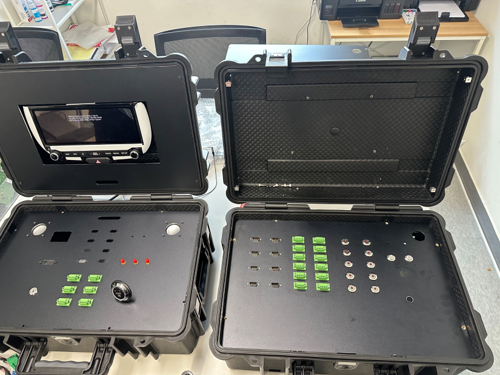
LISA has developed a Hardware-in-the-Loop Simulation (HILS) framework using actual automotive Electronic Control Units (ECUs), gateways, instrument clusters, and other vehicle components to reproduce vehicle communication and operational behaviors under controlled laboratory conditions.
Real-Vehicle Data Collection and Driving Scenario Reconstruction
Using multiple vehicle platforms, including Kia Soul, Kia Booster, Hyundai Casper, and Genesis G80, our research collects network traffic generated under various driving conditions and operational scenarios.
The collected datasets cover heterogeneous in-vehicle communication protocols, including CAN, CAN-FD, LIN, and Automotive Ethernet, allowing researchers to examine differences in network architecture, communication patterns, and ECU behavior across vehicle manufacturers and models.
By replaying real-vehicle network traffic within the HILS environment, we investigate how closely the testbed can reproduce the communication patterns and observable system responses of actual vehicles.
Dataset Reliability and Cross-Platform Evaluation
A key research objective is to evaluate the reliability and representativeness of datasets generated by HILS testbeds compared with datasets collected from real vehicles.
Our research compares network traffic characteristics, message timing, communication patterns, and ECU responses across both environments to identify similarities, discrepancies, and limitations in driving scenario reproduction.
Through experiments involving different vehicle platforms, we also investigate how variations in ECU configurations, network protocols, and vehicle architectures influence dataset characteristics and simulation fidelity.
Cyberattack Simulation and Security Evaluation
The HILS framework provides a controlled environment for generating malicious datasets and performing cybersecurity experiments that would be difficult or unsafe to conduct on operating vehicles.
Researchers can inject malicious messages, reproduce network anomalies, and evaluate different cyberattack scenarios, including replay attacks, fuzzing, denial-of-service (DoS), and abnormal ECU communication.
These capabilities support vulnerability analysis, intrusion detection system (IDS) evaluation, and the investigation of how malicious network activities affect interconnected vehicle components.
By combining authentic automotive hardware, real-world driving datasets, multi-protocol network analysis, and controlled cyberattack experiments, LISA aims to establish a reproducible and trustworthy evaluation environment for next-generation automotive cybersecurity research.
Key Innovation: Instead of moving the vehicle through the environment, we recreate the environment around stationary vehicle hardware—bridging real-world driving experiments and laboratory-based cybersecurity testing.